You have made through the inspections and appraisal and now you are getting to the end of your escrow. What happens next?? Here's a short video to prepare you on the final steps of the last week of your escrow. There are a lot of moving parts but your Realtor and Lender should be navigating you through the entire process so you can close on time, successfully and get the keys to your new home.
Doug Reynolds, a Sacramento area Realtor for over 10 years, offers his opinions and suggestions on how to make the appraisal process as smooth and successful as possible.
Connect with Doug Reynolds Real Estate via Facebook, YouTube, and Follow his Blog.
So you are a buyer or a seller in Sacramento and just got into escrow. What's next?? Well, if there's a loan involved for the buyer then an appraisal will be involved. There's a lot of moving parts with an appraisal from an AMC, point of contact, comps, turn times, minimum property condition requirements.
Doug Reynolds, a Sacramento area Realtor for over 10 years, offers his opinions and suggestions on how to make the appraisal process as smooth and successful as possible.
Connect with Doug Reynolds Real Estate via Facebook, YouTube, and Follow his Blog.
Hi, I'm Doug Reynolds. I'm a Realtor in the Greater Sacramento Area and have been a full time agent since 2006.
In This Video, i talk about How to compete with multiple offers.
Right now it's tough to be a buyer in the Sacramento Real Estate market. There is low inventory and the buyer demand is very high. This formula is making for a fast paced market where multiple offers, over list price are very common on most houses within a few days of hitting the market.
Doug offers his opinions and suggestions on standing out from the pack in order to get your offer accepted on that property you love.
Connect with Doug Reynolds Real Estate via Facebook, YouTube, and Follow his Blog.
Hi, I'm Doug Reynolds.
I'm a Realtor in the Greater Sacramento Area and have been a full time agent since 2006.
In This Video, i talk about all the steps in the home buying process. This is a very quick overview but it can give you some knowledge and direction if you are just starting to think about buying a home. Ultimately, you want to find a great Real Estate Agent that is experienced and can walk you through this entire process from start to finish.
So, take a look at the video to understand the overall process of purchasing a home.
This video should provide great info if you are getting close to buying or selling and want to educate yourself.
Connect with Doug Reynolds Real Estate via Facebook, YouTube, and Follow his Blog.
Hi, I'm Doug Reynolds.
I'm a Realtor in the Greater Sacramento Area and have been a full time agent since 2006.
In This Video, i talk about what a sewer inspection is, why you might want to have one done, and how it works. Over the years i've seen some pretty wild stuff in sewer lines and noone had any idea what was going on until that inspection occurred. It's a pretty cool and incredible process.
So, take a look at the video to understand the ins and outs of sewer inspections.
PS - not all sewer inspection companies are good. contact me for a quality recommendation.
This video should provide great info if you are getting close to buying or selling and want to educate yourself.
Connect with Doug Reynolds Real Estate via Facebook, YouTube, and Follow his Blog.
While shopping for homes (or furniture to put in it), you will quickly see that one particular style is all over the place these days: Mid-Century Modern. So what exactly is Mid-Century Modern?
Fans of the show “Mad Men” may already be conjuring up images of Don Draper’s snazzy Manhattan apartment with floor-to-ceiling windows and that sunken living room, but the classic style is about so much more than chain-smoking guys in skinny ties and women with beehive hairdos.
Mid-Century Modern is actually an architecture and design movement that changed the way many of us live—and its influences are hotter than ever today.
A brief history of Mid-Century Modern architecture
Mid-Century Modern homes began springing up in the mid-1940s, right after World War II, and continued to spread through the 1980s. Soldiers were coming home, starting families, and setting off the baby boom. They needed new homes quickly, and the experimental technologies and materials—steel, aluminum, tempered glass, stucco, and plywood—developed during the war and beyond were quickly applied to residential structures to meet the needs of the growing U.S. population.
The Mid-Century Modern era, which lasted until the 1980s, produced a number of prominent architects, including Philip Johnson, John Lautner, Rudolph Schindler,and Richard Neutra. (Schindler and Neutra were mentored by Frank Lloyd Wright, a seminal American architect.)
When it comes to superstar Mid-Century Modern homes themselves, perhaps the most famous are the Case Study Houses, found mostly in Los Angeles but also in San Francisco and Phoenix. When they were built, the Case Study Houses were designed for affordability, but their value has skyrocketed over the years—and many have been preserved, restored, and maintained by historic organizations.
An Eichler mid-century modern home in Sunnyvale, CA
Nancy Nehring/Getty Images
Elements of Mid-Century Modern architecture
Homes and buildings constructed in the Mid-Century Modern architectural style all have certain elements in common, including the following:
Flat planes and geometric lines: The exterior walls are usually unembellished with round columns, elaborate porches, or bay windows. They are smooth and flat, often accented by geometrically shaped windows. In warmer climates, where snow buildup is not an issue, it’s common for roofs to be flat.
Large windows and walls of glass: The popularity of the sliding glass door and the floor-to-ceiling window originated in the Mid-Century Modern era. They were built in an effort to integrate outdoor nature with indoor living. Houses were designed with the goal being to make sure as many rooms as possible had expansive outdoor views. At the time, this was considered not only aesthetically pleasing but advantageous to one’s health as well.
Open floor plans: In earlier eras, rooms tended to be small in order to promote privacy. But the postwar era of peace and love went hand in hand with more common space. By integrating fewer walls and more open spaces into the floor plan, Mid-Century Modern style encouraged families to share space and feel more engaged with one another.
Varied elevations: Large, open, geometric spaces were broken up with a few small steps, rather than entire stories and staircases. The split-level design and the sunken living room were ways to create rooms without walls. Smooth, unadorned built-in cabinets of varying heights gave the same effect and provided storage.
Typical floor-to-ceiling windows in a mid century modern home.
Bill O'Leary/The Washington Post via Getty Images
If you’re on the market for a Mid-Century Modern home, it won’t come cheap. Due to the popularity of this style, these homes can command as much as 149% more than similarly sized homes of different styles. (Believe it or not, that’s a higher premium than a home designed by Wright!) Still, if you love the look, the appeal does not seem to be waning any time soon, so odds are it’s a great investment that won’t seem outdated.
Hi, I'm Doug Reynolds.
I'm a Realtor in the Greater Sacramento Area and have been a full time agent since 2006.
In This Video, i talk about what Carbon Monoxide Detectors and how they play into the real estate transaction. First off, please understand that is NOT a carbon "di"-oxide detector. Also, NOT a CO"2" detector. Many, many people call it that including appriasers, real estate agents and home owners. Carbon "di"oxide, also know as CO"2" is not dangerous. It is carbon "mon"oxide that we are worried about, or CO.
So, take a look at the video to understand the rules and guidelines for Carbon Monoxide detectors.
This video should provide great info if you are getting close to buying or selling and want to educate yourself.
Connect with Doug Reynolds Real Estate via Facebook, YouTube, and Follow his Blog.
The term “home office” is kind of misleading. It suggests that the room is all about being an extension of a day at the office. Though that can be a part of what happens in them, home offices also are a place to do so much more. This is where people manage finances, organize family paperwork, keep track of schedules, plan events and corral digital photos.
A review of recent popular photos uploaded to Houzz between July and September 2016 reveals some design tips that can help you set up your own home office — whether you’re building a business, managing family affairs or looking for a quiet, contemplative space in which to be creative.
Positioning a desk in a room to face either the entrance or the area where guests or clients sit has a variety of benefits. It makes whoever’s sitting at the desk feel secure because he or she can become aware of when someone enters the room. And it signifies to guests entering the room that the person sitting at the desk is in a position of authority. It’s a good arrangement for anyone who works on sensitive material at home, needs privacy or wants to convey the aforementioned feeling when meeting with clients.
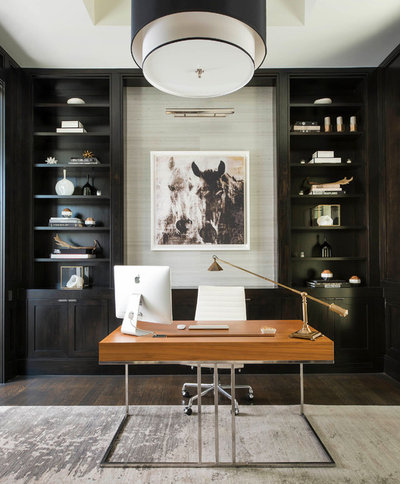
Here, a Dallas office takes on contemporary style with a desk situated in the power position. A contrasting color scheme of black and white-gray exudes a sense of sophistication, as do the complementary textures in the rug and center wall covering.
The power position doesn’t always have to face the entrance, but the desk shouldn’t face away from it. Here, well-scaled furniture lets guests or clients know where they’re supposed to go: to one of the chairs opposite the desk.
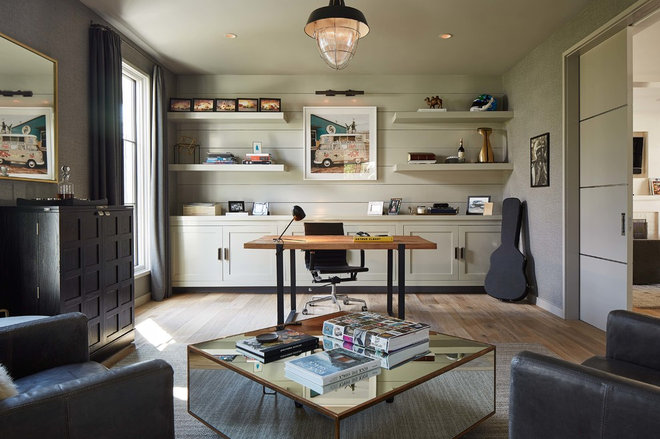
This North Carolina home office takes a similar approach. It also shows that you can establish a sense of authority while still making the room feel comfortable and inviting.
A soothing color palette, oversize leather chairs and a dark cabinet with a bottle of liquor on top beckon guests to come in and kick back — but also to be prepared to get down to business.
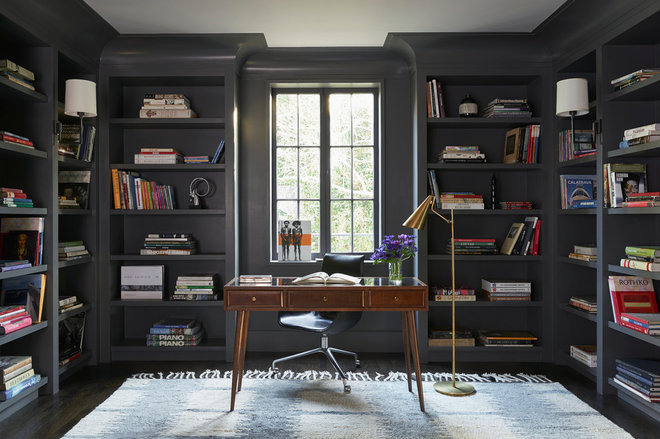
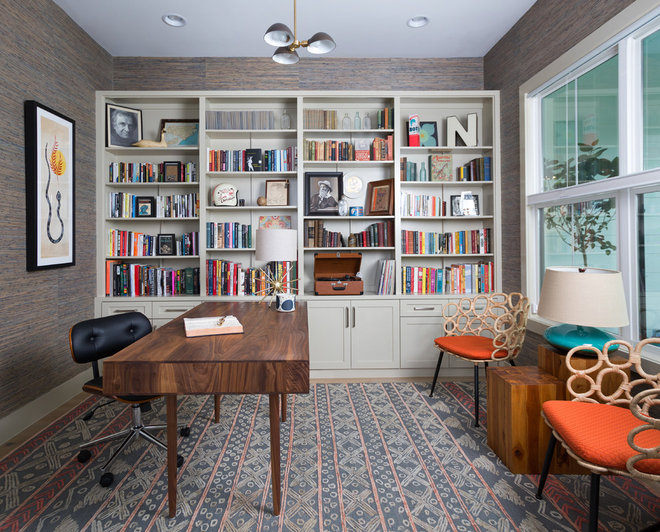
A custom-made walnut desk gives weight to this otherwise delicate Austin, Texas, home office, which features softening elements such as grasscloth wallpaper, a geometric rug and airy chairs.
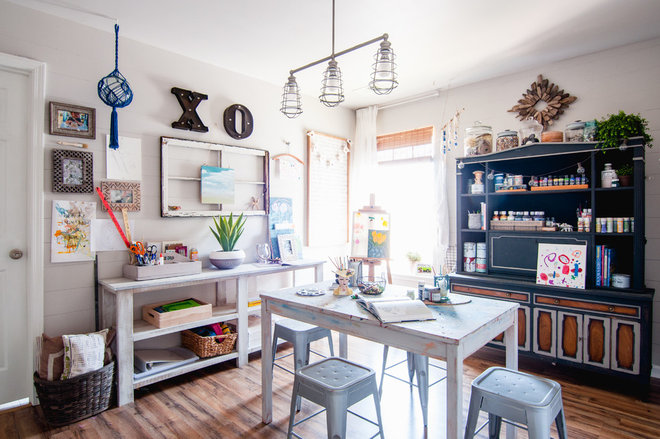
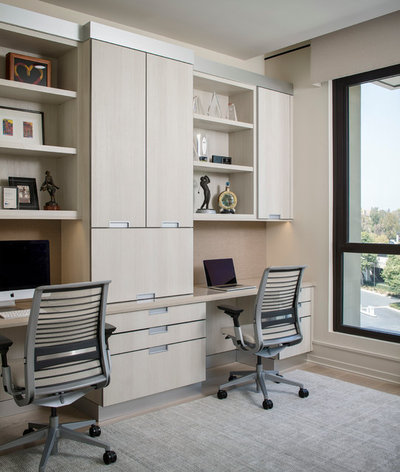
Working from home isn’t always just about checking and replying to email. The following rooms take into account various tasks, such as crafting, printing, meeting with clients and more with things like large or multiple desks and item-specific storage.
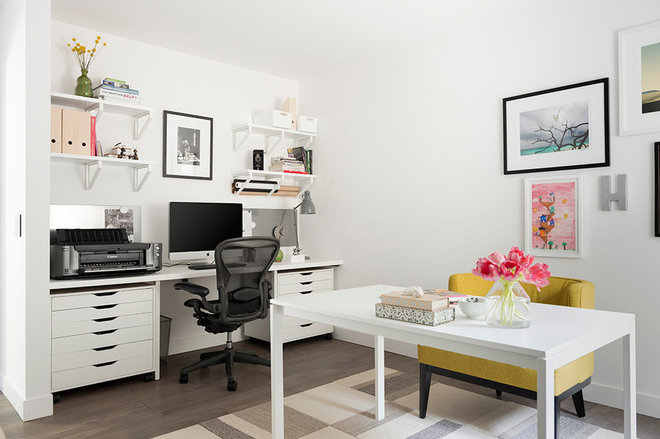
This former children’s bedroom became a postproduction office for a professional photographer, with a separate desk area for processing photos and another for meeting with clients or viewing printouts.
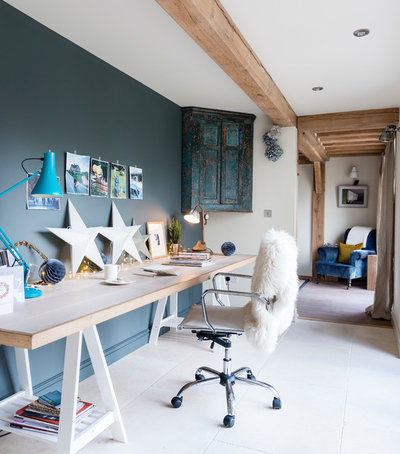
In this home office in England, a large saddlehorse-style desk provides plenty of space for spreading out papers, tackling crafts, and writing cards and letters — the old-fashioned analog kind, of course.
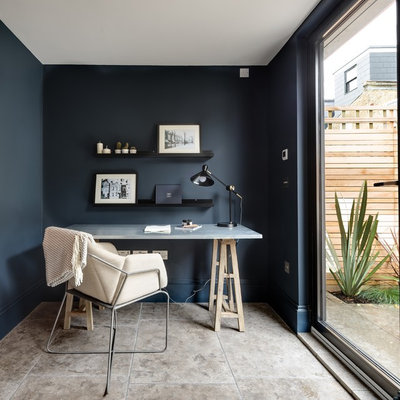
Sometimes work is silent and contemplative. From writing a letter or a novel (or reading one) to learning a new subject to preparing for an important meeting or presentation the following day, a quiet, simple spot can be incredibly beneficial to productivity.
Dark walls, gray stone floors and minimal furnishings set the moody tone in this London office, which opens to an inspiring patio courtyard.
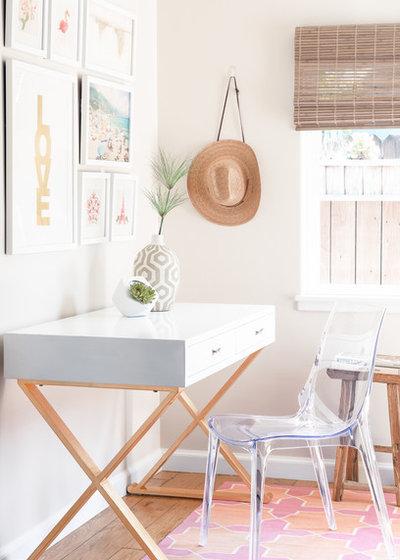
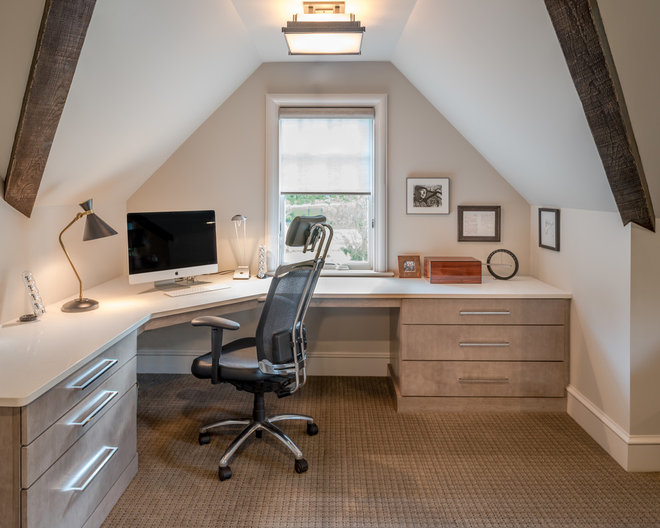
A brightly lit corner desk is sure to get creative juices flowing. In this office in Santa Barbara, California, crisp white walls, picture frames and a desk, plus a clear Lucite chair, help enhance light and clear the mind.
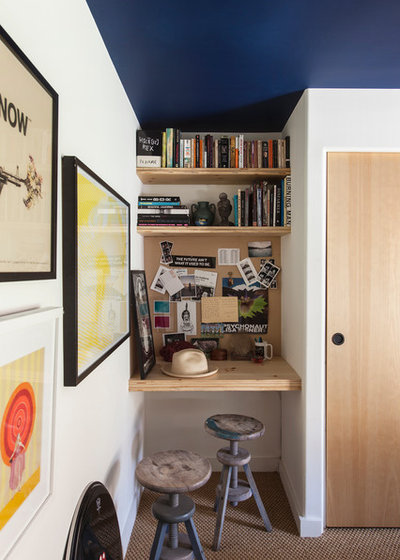
A home office need not take up an entire room. The following homes prove that a little creativity can turn tight nooks and crannies into productive spaces.
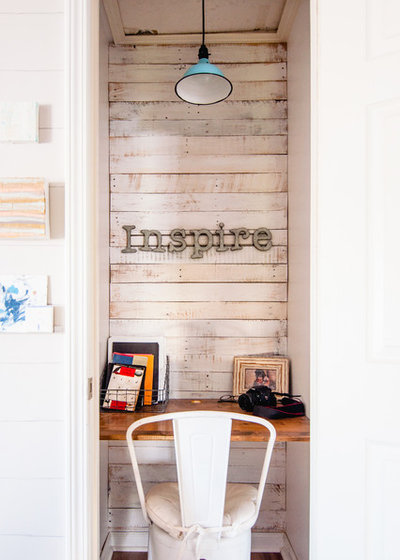
In the same home as the previously mentioned family art studio, homeowner Amanda Hervey also carved out a more private, miniature space in which she can work, read and write posts for her blog, Our Storied Home.
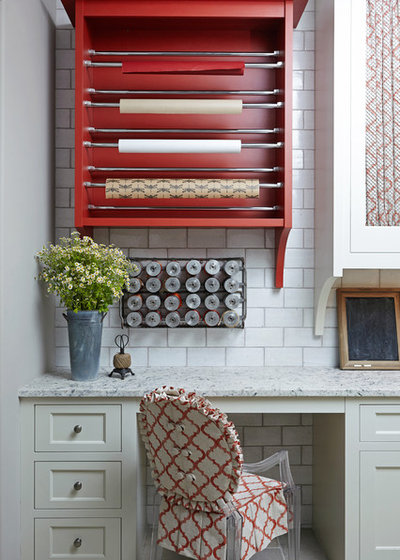
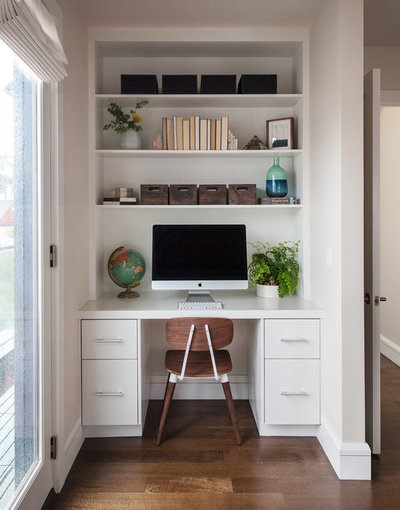
This bedroom niche holds court as a command center, with drawers and bins for organizing important documents and mail in a space that’s large enough to get things done yet compact enough to keep tidy on the fly.
Oftentimes people need an office-like space to manage family schedules, budgets, chores, events and more. And it’s vital to have a carved-out space for such family business.
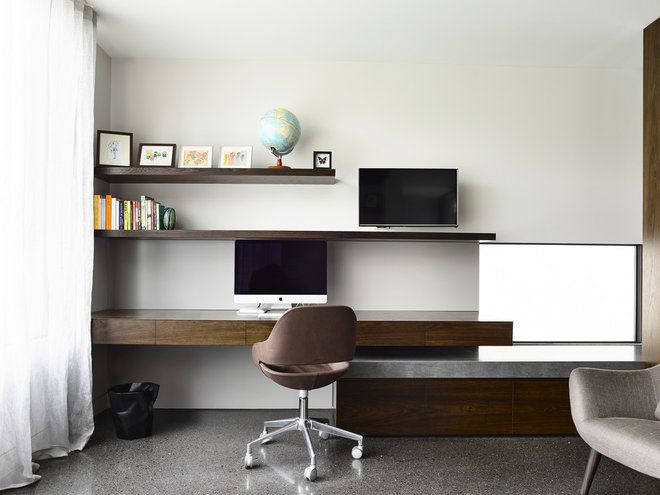
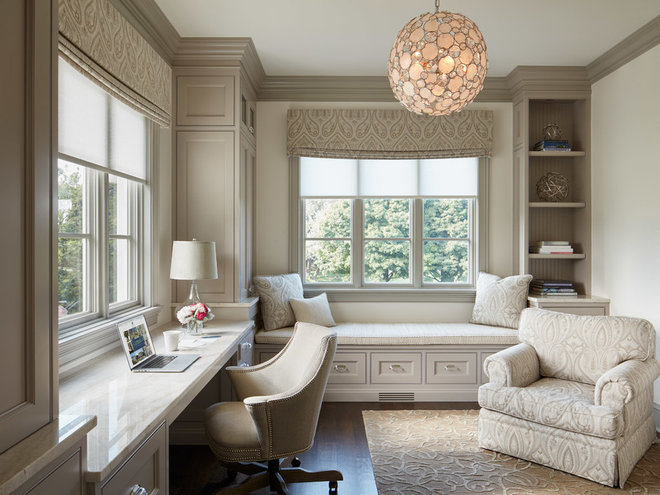
A built-in desk in this new Philadelphia home creates a spacious quiet corner office for catching up on email, organizing family photos and more without distraction.
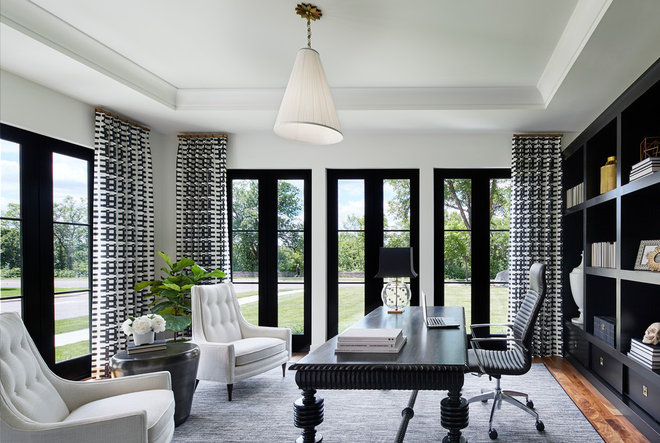
This elegant Chicago office embraces a soft, neutral palette for a calming space in which procrastinating from morning work with a cup of coffee and a leafy view surely comes easily.